
AQB’s minimum education criteria focusing on college degree requirements is a moot point. We should be talking about the outdated 1995 pay model colliding with 2026 workforce expectations.
If we want to uphold public trust and attract competent professionals, we need a sustainable economic roadmap. Otherwise, we’re just guarding a model that worked for us and acting surprised when it doesn’t inspire anyone else.
“In five years, colleges won’t exist.” Hyperbole? Probably. But learning has already shifted. You can now prompt an AI: “Teach me how to write a USPAP-compliant office building appraisal. Build me a Coursera-style curriculum.” It produces a syllabus, lessons, assignments. You get stuck? You ask the AI professor in real time.
Education is becoming conversational, customized and on demand.
Meanwhile, some entrepreneurial parents are questioning college ROI. One friend offered his daughter paid college or the same cash to start a business. Three years later: two coffee shops, four employees, $1.2 million in revenue.
What if we remove the degree requirement and nothing happens? What did we really fix? Lowering a barrier doesn’t create desire. It just lowers a barrier.
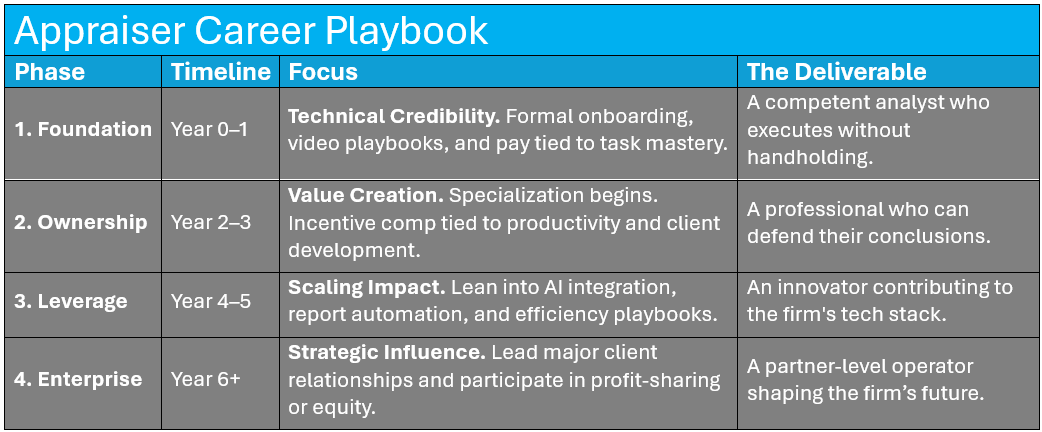
We need to fix the career pathway itself. The 1995 pay model vs. the 2026 workforce. The current appraisal model is stuck in the 90s: Come into the office, read old reports and learn by osmosis. The compensation “ladder” is a slow grind. Start at 35% fee split, inch toward 40% then plateau at 50% after a decade.
There’s no equity. No strategic participation. Just trading hours for a slightly better split. Emerging appraisers want to see a path Years 1, 3 and 5. They want to know how income scales as skills compound. Incentives drive behavior; desire follows visible upside.
Growth must be visible, that’s a non-negotiable. Compensation must scale with contribution. Specialization must be intentional. Ownership must be real.
The licensing debate is important, especially when it comes to public trust, but it’s secondary. The bigger conversation is building a profession people can actually see themselves inside of.
Fix the incentive roadmap. Create a pathway that shows progression phases, timeline, focus and the deliverables.
Then debate licensing requirements.